


THIS ITEM IS UNAVAILABLE. YOU MAY BE INTERESTED IN ONE OF THESE ALTERNATIVES...


Airfix 1:72 D-Day Fighters Gift Set
Product Description
The importance of the role air power played in the months leading up to
D-Day cannot be overstated, with the Allied powers knowing that securing
superiority of the skies over the proposed landing beaches could be the
difference between success and failure of the entire operation.
That being the case, Allied air forces were committed in ever-increasing
numbers from the end of 1943, attacking airfields, supply infrastructure
and other strategic targets, and mounting hundreds of diversionary
attacks. This was all intended to keep German forces guessing as to the
location of the anticipated invasion, but all the time diminishing their
ability to respond to the landings when they came.
With so many Allied aircraft expected to be in the air supporting
Operation Overlord, Allied Commanders were concerned about the
possibility of their aircraft coming under attack from friendly forces
both in the air and from anti-aircraft units on the ground.
They issued a directive that all aircraft (with some exceptions,
including four-engined heavy bombers) be painted with identification
markings around their wings and rear fuselage, under the strictest
levels of security.
The order to begin applying markings to troop transport, aircraft was
not issued until 3rd June 1944, with other units receiving their
instructions the following day. This move placed additional pressure on
airfield staff already working at maximum capacity.
On D-Day itself, over 13,000 individual sorties were flown by Allied
aircraft in support of the amphibious landings and although around 127
aircraft were lost for various reasons during those operations, it's
thought that the adoption of invasion makings significantly reduced
numbers succumbing to incidents of friendly fire on that momentous day.
Although the Luftwaffe were conspicuous by their absence on D-Day
itself, they fought tenaciously in the weeks and months which followed,
highlighting the fact that they were far from finished.
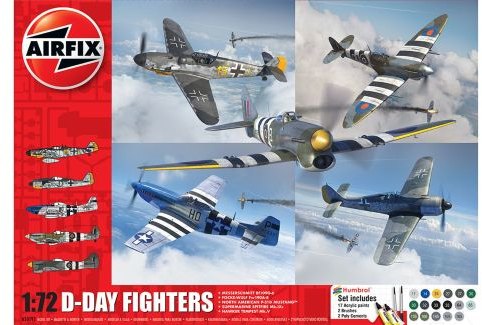
Model kits included:
Supermarine Spitfire Mk.IXc – 26 parts.
North American P-51D Mustang – 53 parts.
Messerschmitt Bf109G-6 – 41 parts.
Hawker Tempest Mk.V – 72 parts.
Focke-Wulf Fw190A-8 – 53 Parts.
What's Inside
Plastic kits, instruction sheets, paint guide, acrylic paint, poly
cement, brushes and decal sheet.
Skill Level 1
